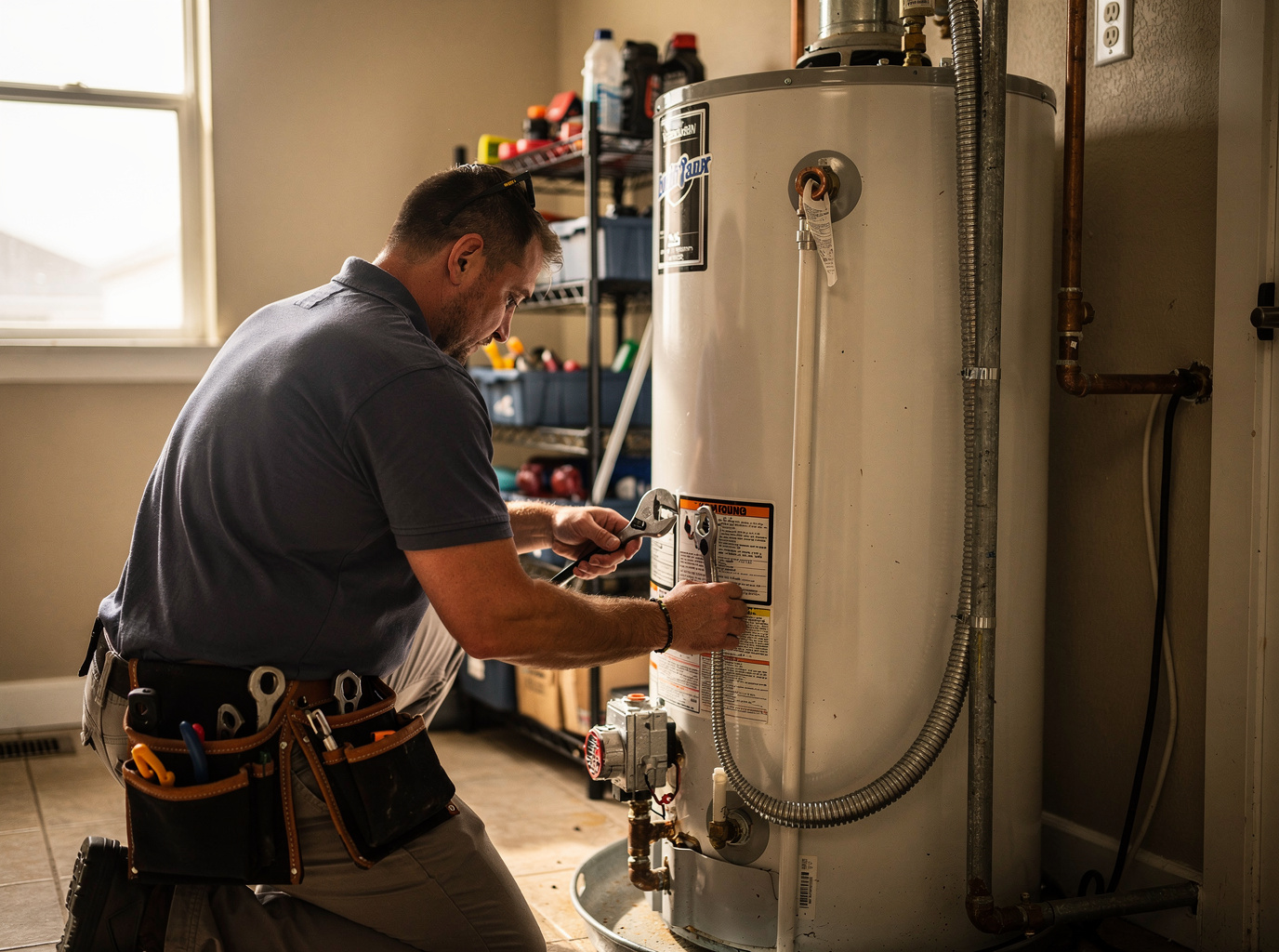
Water heater repair in San Antonio is different from most places in Texas. Our summers push water heaters hard, with ambient garage and attic temperatures often climbing well above what the unit was designed around, and the water coming into homes from the local supply carries enough mineral content to build sediment in the bottom of a tank. Those two conditions together wear out heating elements, thermostats, and anode rods faster than many homeowners expect. We work on tank water heaters in Alamo Heights, King William, Southtown, and Downtown, along with the neighborhoods in between, and we treat every diagnosis as something you can check for yourself.
Our approach starts with a plain-language explanation of what we found. Before we touch a component, we tell you what is failing, what it is doing to the system, and what the repair involves. If the unit is near the end of its service life, we say so and walk through what that means for your next steps. We will not push a replacement when a single part will restore normal operation, and we will not patch a tank that has reached the point where repairs stop making sense.
Why Choose Water Heater Repair San Antonio
We focus on what homeowners in San Antonio actually run into. Most calls we handle involve one of a few failures: a heating element that has burned out in an electric unit, a gas control valve or thermocouple that has stopped holding the pilot, a thermostat that no longer reads correctly, or a tank that is leaking from the bottom seam because sediment has damaged the lining. We know which symptoms point to which failure, and we check the most likely cause first instead of guessing through parts.
We also show you the work. After every job we walk through the old parts next to the new ones, so you can see the burned element, the corroded anode rod, or the cracked thermocouple for yourself and understand why it failed.
Signs Your Water Heater Needs Attention Now
Some problems grow quickly and turn a simple repair into a flood or a no-hot-water emergency. Contact us soon if you notice any of the following:
- Water pooling around the base of the tank, or a damp spot spreading on the floor of a closet, garage, or utility room in Downtown or King William bungalows.
- Rusty or discolored hot water, or a metallic smell when the tap runs hot.
- A popping or rumbling sound during heating, which usually means sediment has built up on the bottom of the tank.
- Lukewarm water even when the thermostat is set high, or water that runs hot for a few minutes and then goes cold.
- A gas unit whose pilot light goes out repeatedly, or a burner that will not stay lit.
- An electric unit that trips its breaker or has one side of the tank producing noticeably less hot water than the other.
Any sign of active leaking should be treated as urgent. Shut off the water supply to the heater and the power or gas supply to the unit before contacting us.
Our Process for Water Heater Repair
Every job follows the same sequence so you know what to expect. We begin by confirming the unit type, age, and fuel source, since electric and gas tanks fail in different ways and require different tools. Next we inspect the system: we check the power or gas supply, test the heating elements or burner assembly, verify the thermostat and thermocouple readings, look at the anode rod condition, and examine the tank base and fittings for leaks. We write up the findings before any repair begins, including what needs to be fixed now, what can wait, and what we recommend if the tank is near the end of its life.
Once you approve the scope, we complete the repair, test the unit through a full heating cycle, and walk you through the old and new parts. We explain the cause of each failure so you can prevent it from recurring.
Parts and Components Inside Your Water Heater
Understanding the parts that fail helps you judge a repair recommendation. In an electric tank, the two heating elements sit inside the tank, one near the top and one near the bottom. Each is controlled by its own thermostat, and the upper element and thermostat typically heat the water first. A burned or shorted element often shows up as no hot water, or hot water that never reaches full temperature. Mineral scale on an element can also cause it to overheat and fail early, which is why the sediment condition matters so much in San Antonio.
In a gas tank, the key parts are the gas control valve, the pilot assembly, the thermocouple, and the burner. The thermocouple is a small sensor at the pilot flame that tells the gas valve the pilot is lit. When it weakens or becomes coated, the pilot drops out as soon as you release the control knob. The gas control valve regulates gas to the pilot and main burner, and a faulty valve can cause ignition failure or allow gas to flow when it should not.
The anode rod is a sacrificial metal rod that draws corrosion away from the tank wall. In hard water it wears out faster, and once it is depleted the tank lining begins to corrode. We inspect the anode rod on every tank and tell you whether it is still doing its job.
The tank itself and its fittings include the drain valve, the temperature and pressure relief valve, the cold-water inlet dip tube, and the hot-water outlet connection. A dip tube that has broken or cracked can send cold water straight to the outlet, causing the water to run lukewarm. A relief valve that drips or sticks needs attention because it is a safety component.
Common Questions About Water Heater Repair Before You Decide
Homeowners often ask whether a single failed part is worth fixing on an older tank. The honest answer depends on the age of the unit, the condition of the tank, and how much of the system has already worn. A new element or thermocouple on a relatively young tank is usually a sensible repair. A burned element on a tank with heavy sediment and a corroded lining may fail again quickly, and we will tell you that directly. Our written findings give you the information you need to make that decision without pressure.
Technician insight
In San Antonio, the thing that catches most people out with water heater repair is hard water sediment. The mineral content in our water settles on the bottom of the tank and bakes onto the lower element, so a heater that seems to be losing capacity often has a scale problem rather than a failing thermostat. I always check the bottom of the tank before deciding which part to replace, because replacing an element in a sediment-filled tank frequently buys only a short stretch of reliable heat.
Pilot Dropout in a Southtown Gas Tank
A homeowner in Southtown reported that the pilot light kept going out as soon as the control knob was released, and the water was only lukewarm after the first few minutes. Our inspection found a weakened thermocouple coated with residue at the pilot flame, which was signaling the gas valve incorrectly, along with sediment near the base of the tank. We replaced the thermocouple, flushed the sediment, and ran a full heating cycle to confirm the pilot held and the water reached temperature. We then showed the homeowner the old thermocouple beside the new one and explained how the sediment had contributed to the strain on the burner.
Water Heater Repair Services We Offer
✓Electric Element Repair
We test both heating elements and their thermostats, then replace whichever has failed so your electric tank heats evenly from top to bottom. Restored heat means hot water runs at the temperature you set again.
✓Gas Control Valve Repair
We diagnose the gas control valve and pilot assembly to find out whether the valve, the pilot, or the thermocouple is causing ignition trouble. Correct diagnosis keeps the burner lighting reliably and avoids replacing parts that still work.
✓Thermostat and Thermocouple Replacement
We check and replace faulty thermostats on electric units and weak or coated thermocouples on gas units. A correctly reading sensor keeps the water at the set temperature and stops the pilot from dropping out.
✓Tank Flushing and Sediment Removal
We drain and flush sediment from the tank to remove the scale that San Antonio's hard water leaves behind. Clearing sediment helps elements and burners run cooler and last longer.
✓Anode Rod Inspection and Replacement
We inspect the sacrificial anode rod and replace it when it is depleted, slowing corrosion on the tank wall. This is one of the most effective ways to extend the life of a tank in hard-water conditions.
✓Leak Diagnosis and Tank Fitting Repair
We trace water leaks to the source, whether a drain valve, a relief valve, a supply connection, or a seam, and repair the failed fitting. Stopping a leak early limits water damage to floors and closets.
✓Dip Tube and Relief Valve Replacement
We replace a broken dip tube that causes lukewarm water and a worn temperature and pressure relief valve that drips or sticks. Both are small parts with outsized effects on comfort and safety.
✓Residential Water Heater Installation
When a tank cannot be restored economically, we install a replacement sized for your household and sized to fit your closet, garage, or utility space. We explain the options in writing before we begin.
How it works
- 1
Confirm the Unit and the Symptoms
We identify whether your heater is electric or gas, check its age and capacity, and ask what you have observed. Those details narrow down the likely failure before we open anything up.
- 2
Inspect the Power or Gas Supply and Controls
We test the breaker or gas supply, the thermostats or gas control valve, and the pilot or burner operation. This shows whether the fault sits in the controls or inside the tank.
- 3
Test the Heating Components
We check element continuity and resistance on electric units, and thermocouple output and pilot behavior on gas units. Measured results replace guesswork.
- 4
Examine the Tank, Anode Rod, and Fittings
We look for sediment, corrosion, and leaks at the base, drain valve, relief valve, and connections, and check the anode rod condition. This tells us whether a repair will hold or whether the tank is failing from within.
- 5
Write Up the Findings Before Any Work Begins
You receive a written explanation of what we found, what must be repaired now, what can wait, and whether replacement makes more sense. We do not start repairs until you have reviewed that information.
- 6
Complete the Repair and Run a Full Heating Cycle
After the approved work, we restore power or gas, refill the tank, and run the heater through a full cycle to confirm it reaches temperature and holds it. We check for leaks at every connection before we leave.
Pricing
We put our findings and repair options in writing before any work starts, so you decide with the facts in front of you and never face surprises once the job is underway.